
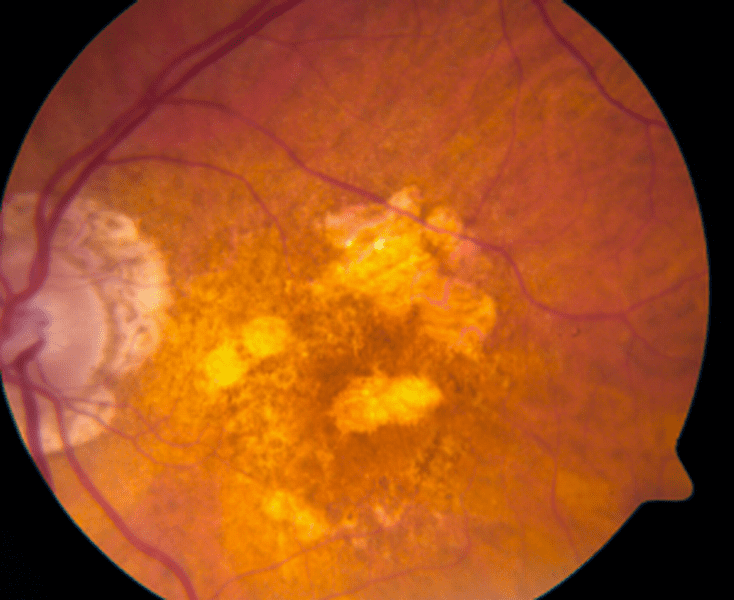
Understanding Macular Degeneration
This is the patient handout we give at the office regarding Age-related Macular Degeneration, its causes, beneficial lifestyle modifications and treatments for both wet and dry AMD.

For years, patients with dry macular degeneration were told the same thing: "We'll watch it." Now, there's a new answer — and it doesn't involve needles, surgery, or drops.
Age-related macular degeneration, or AMD, is one of the leading causes of vision loss in Americans over 50. The "dry" form accounts for roughly 80% of all AMD cases, and for a long time, it was the type that doctors had the least to offer patients.
Here's what's happening inside your eye when you have dry AMD: at the back of your eye sits a thin layer of tissue called the retina, and right at its center is a tiny but incredibly important area called the macula. The macula is what gives you sharp, detailed, straight-ahead vision — the kind you need to read a menu, recognize a face across the room, or watch your grandchildren play.
In dry AMD, tiny deposits called drusen build up under the macula. Over time, these deposits damage and kill the retinal cells that your central vision depends on. In its later stages, dry AMD can progress to geographic atrophy — a condition where patches of retinal cells die off completely, leaving permanent blind spots in your central vision.


The sobering reality: once those cells are gone, they don't come back. That's exactly why early detection and early treatment matter so much. Vision lost to AMD is very difficult — often impossible — to recover. But vision protected is vision kept.
For years, the treatment options for dry AMD were limited. Patients were advised to take specific vitamin supplements, eat a diet rich in leafy greens and omega-3 fatty acids, quit smoking, and protect their eyes from UV light. These are all still good ideas — but let's be honest about what they are: they were management strategies, not treatments. "Take these vitamins and hope for the best" was, for a long time, the most we could offer. That's not a criticism of medicine — it was simply the reality of a disease that had no real therapeutic answer. Patients did everything right and still watched their vision slowly fade.
The wet form of AMD (a more aggressive type where abnormal blood vessels grow under the retina) had injection-based treatments available. But dry AMD patients were largely left waiting — waiting for their vision to worsen, watching the eye chart blur a little more at each visit. Hope and prayer are powerful — but our patients deserved a real clinical tool to go alongside them.
That tool arrived in November 2024.
The Valeda Light Delivery System became the first and only FDA-authorized treatment for dry AMD to actually improve vision. This is not an exaggeration or marketing language. It is a genuine milestone — a first in the history of treating this disease. Now, for the first time, we can look a dry AMD patient in the eye and say: we have something real to offer you.
Valeda uses a technology called photobiomodulation, which sounds complex but is actually a beautifully simple concept: using specific wavelengths of light to stimulate your cells and help them function better.
Valeda delivers targeted, eye-safe light using three specific wavelengths — red, amber, and near-infrared — that penetrate the retina and stimulate the mitochondria inside your retinal cells. Mitochondria are the energy-producing engines of every cell in your body. When they work better, your cells stay healthier longer.
Think of it like this: your retinal cells are workers in a factory. In dry AMD, the power supply to that factory starts failing. The workers slow down, make mistakes, and eventually the factory shuts down. Valeda is like restoring the power grid — giving those workers the energy they need to keep doing their job.
Treatment is delivered through a gentle column of eye-safe light. Your pupil does not need to be dilated, and the treatment can even be performed through a closed eyelid. There are no needles. No incisions. No recovery time.
This isn't experimental. Valeda was tested in rigorous clinical trials before the FDA granted its authorization.
In the pivotal LIGHTSITE III trial involving 100 patients with early to intermediate dry AMD, the results were striking. Over 55% of treated patients gained at least one full line of vision on the eye chart. More impressive still: more than 25% of patients gained two or more lines of vision — that's the difference between struggling to read large print and being able to read a menu again. And more than 15% of patients gained three or more lines — a level of improvement that, before Valeda, simply wasn't achievable in dry AMD with any treatment.
To put those numbers in perspective: these are patients who were on a slow, predictable road toward vision loss. Valeda didn't just slow that road — for many of them, it reversed direction.
Even more important may be what Valeda did for the worst outcome in dry AMD: geographic atrophy. Geographic atrophy (GA) is the end-stage form of dry AMD where retinal tissue dies completely, leaving permanent blind spots. In the LIGHTSITE III trial, only 1.1% of Valeda-treated eyes developed new geographic atrophy — compared to 9.1% of the untreated control group. That is an approximately 73% reduction in the development of geographic atrophy. For a disease that has no cure, preventing its most devastating complication is nothing short of remarkable.
The longer-term results reinforce this picture. After nearly four years of continued treatment, patients maintained a mean gain of 5.5 letters, and over 60% of treated patients were still showing vision benefit of more than one line. Investigators concluded that the data demonstrates Valeda is "potentially modifying the trajectory of vision loss in dry AMD patients and can offer sustainable benefits over several years with continued treatment."
That phrase — modifying the trajectory — is the key. Valeda isn't promising a cure. No treatment for AMD can currently make that claim. But it is the first treatment shown to meaningfully change the course of the disease itself — protecting vision that would otherwise be lost.
One of the most reassuring things about Valeda is how simple and comfortable the treatment process is.
The initial series: A full course of Valeda treatment consists of nine sessions per eye, delivered three times per week over a three- to five-week period. You come into our office Monday, Wednesday, and Friday — or a similar schedule that works for you — for about three to four weeks.
What happens during each session: You'll be asked to remove your glasses or contact lenses. Your eyes will not be dilated. You'll sit comfortably at the Valeda device while a trained member of our team guides you through each step. The entire treatment takes less than five minutes per eye. You can drive yourself home. There is no downtime.
Maintenance treatments: After your initial series, maintenance treatments are recommended approximately every four months — up to three times per year. This ongoing schedule is what sustains the benefits and continues to support your retinal health over time.
The treatment has shown a strong safety profile, with no serious side effects reported during clinical trials. For most patients, the experience is simply sitting in a chair and letting a gentle light do its work.
Valeda is designed specifically for patients with early to intermediate dry AMD. This is actually good news, because it means treatment should start before you've lost significant vision — not after.
Ideal candidates are those with best corrected visual acuity between 20/32 and 20/70, and who have dry AMD characterized by medium or large drusen deposits, or non-central geographic atrophy.
The critical message here is timing. The clinical trials consistently showed the greatest benefit in patients who were treated earlier in the disease process. Waiting until your vision is severely compromised is waiting too long. If you or someone you love has been diagnosed with dry AMD — or if you're over 60 and haven't had a comprehensive retinal exam recently — now is exactly the right time to find out where you stand.
Losing central vision doesn't just make it harder to read. It gradually strips away independence. Patients with advanced AMD stop driving. They stop recognizing faces. They struggle to cook, manage medications, and navigate their own homes safely. Depression rates in patients with significant vision loss are substantially higher than in the general population.
Protecting your vision is protecting your quality of life. It's protecting your ability to stay active, stay independent, and stay connected to the people and activities that matter most to you.
For the first time, dry AMD patients have a real treatment option — not a supplement, not a lifestyle change, but an FDA-authorized, clinically proven therapy that can genuinely help preserve and even improve the vision they have today.
If you have been diagnosed with dry AMD, if a family member has the condition, or if you're simply overdue for a comprehensive eye exam, we want to hear from you. Our practice offers the Valeda Light Delivery System, and we are committed to helping every appropriate patient access this breakthrough therapy.
Here's what we ask you to do right now:
Call our office today to schedule a Valeda candidacy evaluation. This is a comprehensive exam where we assess the current state of your retina, determine your level of AMD, and tell you exactly whether Valeda is right for you.
You've been told "there's nothing we can do" for long enough. That's no longer the whole truth. There is something we can do — and we'd like the chance to do it for you.
Don't wait for your next scheduled appointment. Call us today.
Your vision is worth protecting — and now, more than ever, we have the tools to help.
This blog is intended for informational purposes only and does not constitute medical advice. Please consult with a qualified eye care professional to determine whether Valeda treatment is appropriate for your individual situation.


